Every sound, no audio files
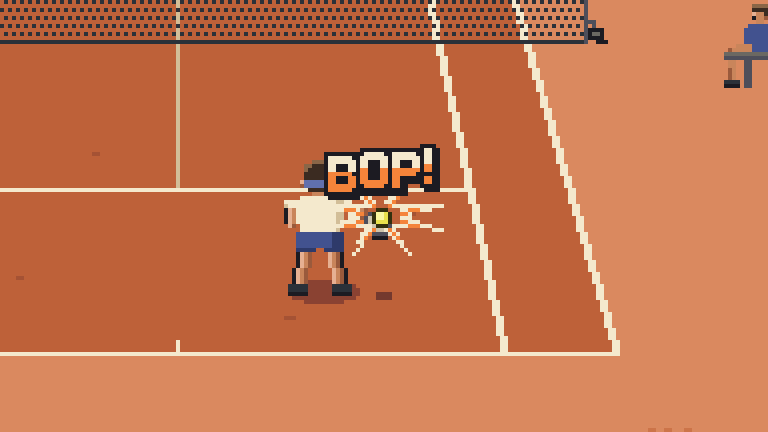
tennisBOP has no audio files. Every sound you hear is built in the browser while you play, the way 16-bit sports games did it.
Two building blocks
There are only two ingredients. One is a pitched tone with an envelope and a pitch slide. The other is a short burst of filtered noise. Every sound in the game is a few of those layered together, and each one lives in a single table, so tuning a sound means changing numbers, not re-recording anything.
The game itself doesn't know sound exists. The simulation reports what happened, a hit, a bounce, a fault, and a separate layer turns those events into sounds. That keeps the tennis logic clean and testable.
What you hear
Each shot has its own hit. The drive is low and fat, the slice a bright scrape, the lob soft and rising, the volley a click and the smash a crack. Better contact sounds better: a weak hit goes dull, and a jammed ball off the wrong side of your body is a wooden thud. Fast serves get a whip.
Bounces change with the court. Clay is gritty, grass is muffled and a hard court pops. There's a net cord, and the BOP! itself is a punch, a rising sweep and a chime.
Then the stingers: a sour buzz for a fault and two for a double fault, two falling notes for out, a rising pair when you win a point, a whip and a chord for an ace, and growing fanfares for a game, a set and the match.
To tune all this by ear, there's a sound board: one button for every sound in the game.
The crowd that didn't make it
I tried a crowd twice. The first was a murmur that swelled during rallies. It pulsed like wind every few seconds, even on the title screen. The second was rebuilt from scratch: applause clap by clap, each clapper with their own pitch and pace, and soft chatter between points.
On a phone speaker it sounded like bees. So the crowd is gone. If it comes back, it'll be a small recorded sample, not more synthesis. Sometimes the best sound design is knowing what to cut.
Update, October 2026: the crowd did come back, as real recordings, in the three stadiums, with an umpire to call the score. Everything else is still synthesised. The story is in "Bigger courts, real crowds".