Bigger courts, real crowds
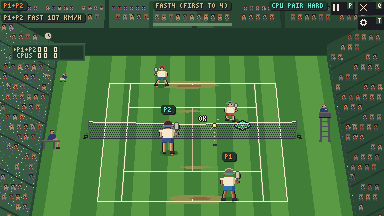
The four club courts were made for quiet rallies. This week tennisBOP got show courts: three stadiums, full stands and a bigger court to play on.
Three stadiums
The Bowl is a steep stadium at night, with floodlights, a ring of lit suites and photographers by the court. Grand Lawn is a green two-tier stadium in the afternoon, with a royal box and a lawn worn bare at the baselines. Centre Court has the same stands with a blue hard court, and it's now the game's home.
The stands are worked out through the game's own camera, one ray at a time, so every row sits in true perspective round the court. They're full of people a few pixels tall, with hair, faces and shirts, and some with flags, fans or drinks. They clap after a point. At The Bowl they stand for a game, and at Grand Lawn they save it for a set.
A bigger court
The court is drawn bigger now, and the picture is taller than your screen. The camera scrolls to follow the rally, so a deep lob takes you to the back of the court and the view comes home for every serve. Between the baselines there are now 118 rows of pixels instead of 93, so you can see more clearly where the ball will land.
The court has real walls too. A ball that bounces in and then hits the back wall is a winner. One that hits the wall on the full is out.
Surfaces and footwork
Surfaces now bounce like the real thing, using the measurements tennis officials use to rate courts. Clay is slow and high, grass is fast and low, and hard courts play in between. Your footing changes too: you slide on clay, grip least on grass and grip best on a hard court. Players take a first step, split-step as the ball is hit, backpedal and brake, so getting into position early is a skill you can feel.
The crowd came back
Last week, the synthesised crowd sounded like bees and got cut. We said that if it came back, it would be as a recording. It did. The stadiums now play real applause, built from free public-domain recordings, and each clip lasts exactly as long as the crowd's reaction on screen. A point gets a ripple of claps. A set gets the whole stadium on its feet.
There's an umpire now as well, with a line judge for the outs and faults. They only call the score, and they're recorded with an AI voice, which the setting says plainly: Umpire (AI voice). One tap turns them off.